How Do Scientists Test Whether Humpback Whale Songs Are Learned Rather Than Innate?
Humpback whales are famous for their complex songs, which can contain repeated phrases, changing sequences, and distinctive acoustic patterns. These vocal displays raise an important scientific question: are humpback whale songs primarily inherited biological behaviors, or do whales learn how to produce and modify them through experience?
Understanding the answer can help researchers investigate whale communication, cultural transmission, and the development of vocal behavior. It can also deepen our appreciation of humpback whales encountered during the breeding season in Samaná Bay, Dominican Republic.
Scientists cannot answer this question simply by listening to a single whale sing. Instead, they combine long-term acoustic recordings, observations of individual whales, comparisons across age groups, and evidence of how vocal patterns change over time.
What Does It Mean for a Whale Song to Be Learned or Innate?
An innate behavior is one that develops largely through inherited biological mechanisms rather than requiring the individual to learn the behavior by copying another animal. A learned behavior changes through experience, observation, practice, or interaction with others.
In reality, vocal behavior does not always fit neatly into these two categories. Biology can influence the sounds an animal is capable of producing, while learning can influence which sounds it produces and how it organizes them.
Humpback whales are widely recognized as vocal learners. Research has shown that their songs can change over time and that song patterns can spread between groups. However, scientists continue to investigate precisely how individual whales acquire their songs, how early vocal development works, and how biological constraints interact with social experience.
The key question is therefore not whether biology or learning matters exclusively. It is how researchers identify the contribution of each.
1. Recording Whale Songs Over Long Periods
One of the most useful approaches is to record whale vocalizations repeatedly over weeks, months, or multiple seasons.
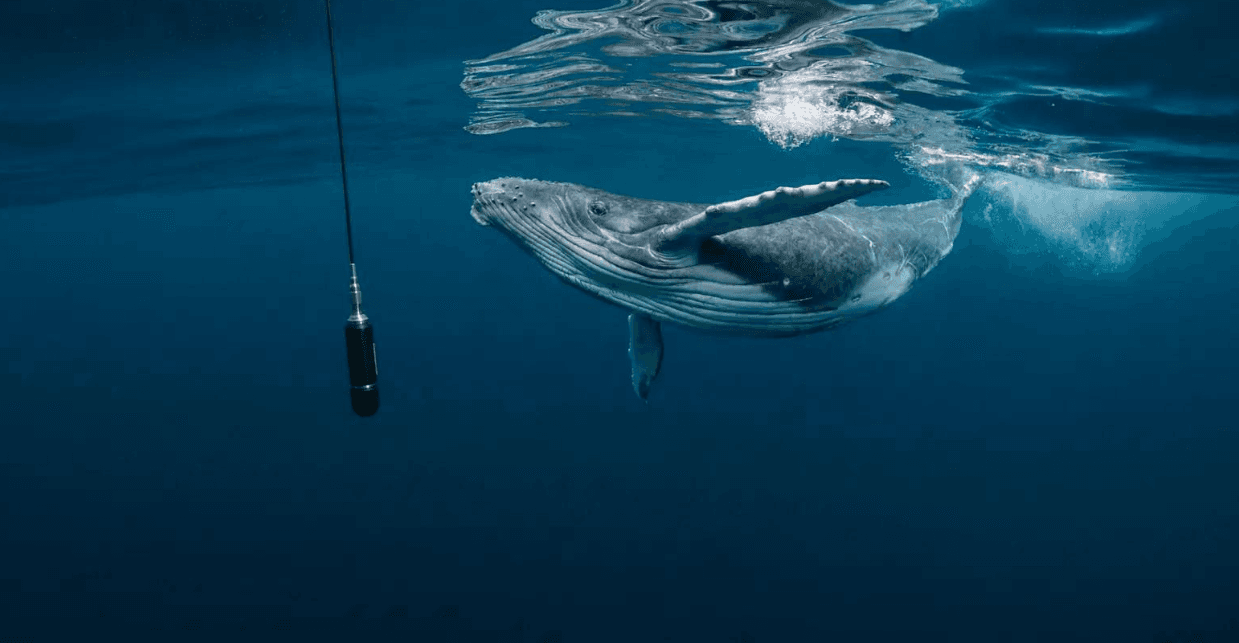
Researchers use underwater microphones called hydrophones to capture sounds that may be difficult or impossible to hear clearly from the surface. Depending on the study, hydrophones may be deployed from research vessels, moored instruments, or other suitable recording platforms.
Scientists then examine the recordings for recurring acoustic units, phrases, and sequences. They may compare these patterns across different recording sessions to identify changes in song structure.
If a whale's vocal behavior changes substantially with experience or over time, that can help researchers investigate learning. Nevertheless, change alone is not conclusive evidence: development, seasonal changes, individual variation, and differences in recording conditions can also influence the observations.
Long-term recordings are valuable because they provide a timeline rather than a single snapshot of vocal behavior.
2. Comparing Young and Adult Whales
Researchers can investigate vocal learning by comparing the sounds produced by whales at different life stages.
Young whales may develop vocal skills as they mature, while adults may produce more established song patterns. Studying these differences can help scientists ask when particular vocal features appear and whether they become more consistent with age.
However, age-related differences do not automatically demonstrate learning. Young and adult whales may differ because of physical development, experience, social exposure, or several factors acting together.
Reliable conclusions require repeated observations and careful comparisons between individuals whose ages and identities can be established with reasonable confidence.
In wild populations, obtaining such information is challenging. Scientists may not know the exact age or complete life history of every whale they record, so they must account for uncertainty when interpreting their results.
3. Looking for Evidence of Imitation
A particularly informative approach is to investigate whether whales reproduce acoustic patterns that were previously produced by other individuals.
Scientists can compare recordings to determine whether a new phrase or song pattern resembles one already documented in another whale or group. They can then examine when the pattern appeared, how frequently it was recorded, and whether its use spread among singers.
Evidence becomes more persuasive when researchers can establish a plausible sequence of exposure and subsequent changes in vocal behavior.
Even so, similarity alone does not prove imitation. Two whales may produce similar sounds independently, and researchers may have missed earlier examples of a pattern. Researchers therefore consider timing, repeated observations, and alternative explanations rather than relying on a single matching sound.
This method helps distinguish possible social learning from simple resemblance.
4. Examining Changes in Song Structure
Humpback whale songs are not just collections of unrelated sounds. They can contain organized sequences of units and phrases that recur in recognizable patterns.
Scientists use spectrograms—visual representations of sound frequency over time—to compare the structure of these sequences. Acoustic measurements can help identify differences in pitch, duration, repetition, and the arrangement of sound units.
If a song pattern changes gradually or a new sequence appears, researchers can investigate whether the change is associated with individual development, experience, or broader social trends.
For example, researchers might compare recordings from the beginning and end of a breeding season. They could ask whether particular phrases remain stable, whether some units are replaced, or whether different singers begin producing similar sequences.
These observations help describe how vocal patterns develop, but identifying the underlying mechanism requires additional evidence.
5. Comparing Whales With Different Social Experiences
Learning depends on opportunities for exposure and interaction, so social context can be important.
Researchers may compare vocalizations from whales observed in different groups, locations, or social circumstances. If individuals with opportunities to encounter the same singers later produce similar patterns, the observations may support a learning hypothesis.
However, whales are mobile, and researchers cannot always establish exactly which individuals heard one another. Two whales recorded in different locations may have shared an earlier environment or encountered the same singers outside the observation period.
Scientists must therefore be cautious when interpreting social relationships from acoustic similarities alone.
Combining sound recordings with photo-identification, movement data, and documented encounters can improve the analysis, although each method has its own limitations.
6. Distinguishing Vocal Learning From Biological Development
A major challenge is separating learned behavior from changes caused by physical maturation.
As whales grow, their bodies and vocal production systems develop. Their ability to produce certain sounds or control vocal features may change with age. Researchers need to consider these possibilities when studying differences between young and adult animals.
One useful strategy is to track multiple acoustic features rather than focusing on a single characteristic. Scientists may examine whether changes occur in sound production, sequence organization, or both.
If a feature appears in a consistent developmental pattern across individuals, it may suggest a biological contribution. If vocal patterns closely follow exposure to other singers, that may support a learning explanation.
Neither pattern necessarily excludes the other. Biological development can provide the foundation for vocal behavior while learning shapes how that ability is used.
7. Testing Whether New Song Patterns Spread
Changes in humpback whale songs can sometimes be observed across groups or breeding areas. Scientists investigate these patterns to understand whether vocal behavior spreads through social contact.
To test this possibility, researchers compare acoustic recordings collected at different times and places. They look for recognizable song features, estimate when those features appeared, and assess whether their distribution is consistent with a proposed pathway of transmission.
A convincing explanation requires more than finding the same phrase in two locations. Researchers must consider migration, incomplete sampling, independent changes, and the possibility that the pattern existed earlier than the available recordings suggest.
When several independent lines of evidence support the same interpretation, the case for cultural transmission becomes stronger.
8. Why Researchers Need Repeated Observations
A single recording rarely provides enough information to determine how a song was acquired.
Repeated observations help researchers distinguish persistent characteristics from temporary variations. They can also reveal whether a vocal pattern appears consistently, develops over time, or changes following potential exposure to other singers.
Long-term monitoring is especially valuable because humpback whales migrate and their vocal activity varies with season and social context.
For studies connected to Samaná Bay, researchers would ideally combine recordings from the local breeding season with observations from other relevant periods or locations. This could help establish which patterns are stable, which change, and whether local observations fit broader patterns of humpback whale vocal behavior.
Such conclusions must be based on actual recordings and documented observations rather than assumptions about what whales in the bay are doing.
9. Can Scientists Prove That a Song Is Entirely Innate?
Demonstrating that a complex vocal behavior is entirely innate is difficult, particularly in a wild animal whose early experiences cannot be fully controlled or observed.
Researchers generally look for evidence that supports or challenges competing explanations rather than treating one observation as absolute proof.
For example, a vocal pattern that appears consistently across individuals might suggest a strong biological influence. Yet similarities could also result from shared learning environments or widespread exposure to common song patterns.
Conversely, a pattern that changes with social exposure may indicate learning, but biological constraints can still shape which sounds are possible.
Scientists therefore evaluate the strength of the evidence, the assumptions behind their methods, and the limitations of their data.
10. How Acoustic Technology Supports the Research
Modern acoustic analysis helps researchers investigate vocal learning in ways that would be difficult through listening alone.
Depending on the study, scientists may use:
- Spectrograms: to visualize changes in sound frequency and timing.
- Signal-processing software: to measure acoustic features and identify recurring patterns.
- Automated detection tools: to locate possible whale vocalizations within long recordings.
- Statistical analysis: to test whether observed similarities or changes are meaningful.
- Photo-identification and movement records: to connect acoustic observations with known individuals or possible social encounters.
Automated systems can speed up analysis, but they do not eliminate uncertainty. Background noise, overlapping singers, changing recording equipment, and imperfect detection can all affect results. Human review and transparent analytical methods remain important.
What This Research Means for Samaná Whale Watching
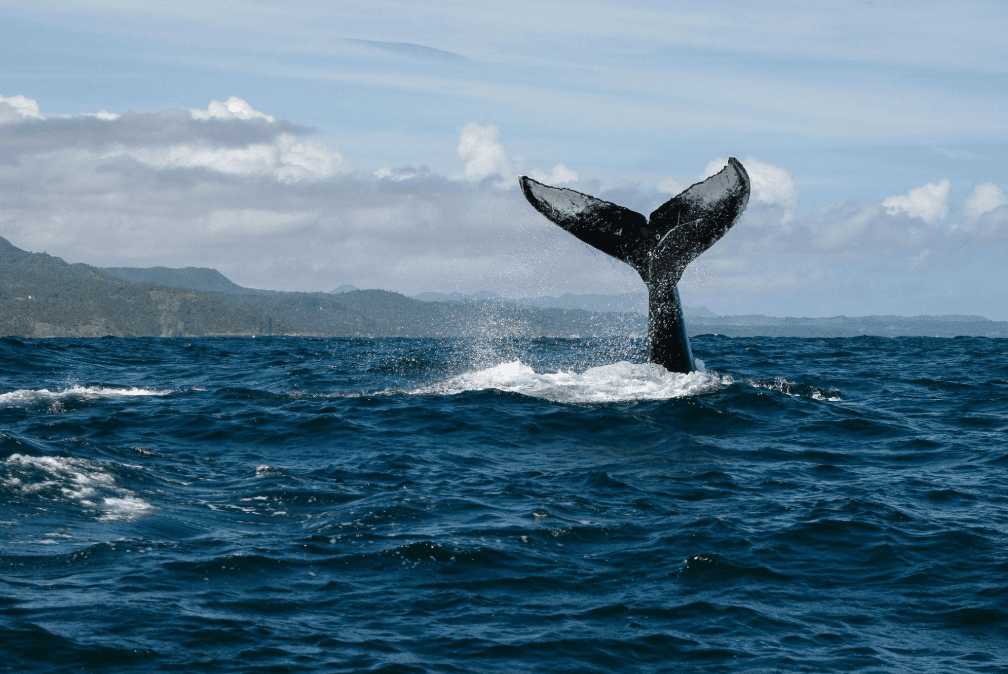
Samaná Bay is known as a seasonal destination for observing migrating humpback whales. Visitors may see whales breaching, surfacing, swimming, or interacting, while many aspects of their underwater communication remain out of sight.
Understanding vocal learning offers a different way to appreciate these animals. A whale song is not merely a collection of sounds; it may reflect a combination of biological ability, individual development, experience, and social influence.
However, visitors should not assume that a particular whale is copying another singer or learning a new song simply because it is vocalizing. Establishing such conclusions generally requires acoustic recordings, repeated observations, and appropriate scientific analysis.
Responsible whale-watching practices are also important. Following applicable local rules, maintaining appropriate distances, and avoiding attempts to chase or disturb whales help reduce interference with their natural behavior.
Conclusion
Scientists investigate whether humpback whale songs are learned rather than innate by combining long-term acoustic recordings, comparisons across life stages, song-structure analysis, social observations, and evidence of vocal patterns spreading between individuals or groups.
The strongest explanations account for both biology and experience. Humpback whales possess the physical and neurological abilities needed to produce vocalizations, while learning can shape how songs are developed, organized, and changed.
For anyone interested in Samaná whale watching, this research reveals another layer of the whales' lives—one that cannot be understood through surface observations alone. It also demonstrates why careful scientific monitoring is essential for separating plausible explanations from conclusions supported by evidence.

Local explorer & expert guide in Samaná Bay Whale Watching.