What Can You Learn From a Humpback Whale’s Tail Fluke?
When a humpback whale lifts its tail above the ocean, it offers a fascinating glimpse of one of the animal's most recognizable features. The broad, powerful tail, known as a tail fluke, helps the whale move through the water and can reveal useful information about its identity and physical characteristics.
In Samaná Bay, Dominican Republic, visitors may see humpback whales lifting their flukes before diving. These moments are exciting to observe, but they are also interesting from a scientific perspective. The shape, coloration, and markings on a whale's fluke can help researchers distinguish one individual from another.
Understanding the humpback whale tail fluke adds another dimension to whale watching. Instead of seeing only a whale disappearing beneath the surface, you can begin to appreciate the anatomy and natural markings that make each animal distinctive.
What Is a Humpback Whale Tail Fluke?
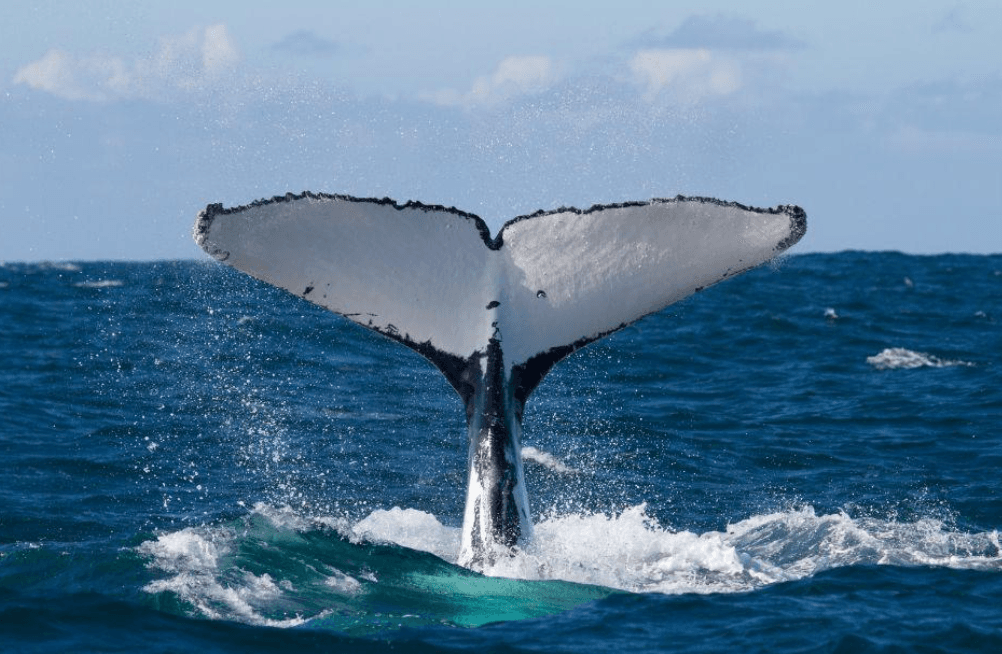
A tail fluke is the broad, horizontal structure at the end of a whale's body. Unlike the vertical tails of most fish, a whale's flukes extend horizontally and move up and down as the animal swims.
The flukes are connected to powerful muscles in the whale's tail stock, allowing the animal to generate the thrust needed for movement. Their large surface area helps the whale propel its enormous body through the ocean.
Humpback whale flukes have two lobes, separated by a notch in the middle. The outer edges and central notch vary in appearance from one whale to another.
Although the fluke is often the last part of a humpback whale visible during a dive, it serves a much more important purpose than simply providing a memorable sight for observers.
How Does a Humpback Whale Use Its Tail?
A humpback whale depends on its tail for efficient movement through the water. Its flukes work together with the body's muscles to produce powerful strokes.
Propulsion through the ocean
When a humpback whale moves its tail up and down, it pushes water and generates forward thrust. This movement helps the animal travel between feeding grounds and breeding areas.
Humpback whales undertake long migrations between colder feeding waters and warmer tropical regions, including Samaná Bay. Their powerful tails are essential to these journeys.
Controlling movement
Tail movements also contribute to changes in swimming speed and direction. Together with the whale's pectoral fins and body movements, the flukes help it maneuver underwater.
Different movements can serve different purposes depending on the whale's activity and surroundings.
Supporting powerful dives
Before some dives, a humpback whale arches its back and raises its tail above the surface. This movement is commonly called a fluke-up dive.
However, not every dive involves a visible tail lift. A whale may disappear beneath the water without exposing its flukes, depending on its swimming angle and behavior.
Why Are Humpback Whale Flukes Different in Color?
One of the most interesting characteristics of a humpback whale's tail fluke is its pigmentation.
The underside may contain areas of white, black, gray, and intermediate shades. The arrangement of these colors can vary considerably between individuals.
Some whales have predominantly dark undersides, while others show extensive white areas. Many display a combination of light and dark markings.
These patterns are useful because they create a distinctive visual appearance. Researchers can photograph the underside of a whale's fluke and compare the image with photographs collected during earlier encounters.
Coloration alone does not tell the complete story, but it can be an important part of identifying an individual whale.
What Do the Markings on a Tail Fluke Reveal?
A humpback whale's fluke can provide clues that researchers use to distinguish individuals.
Pigmentation patterns
The arrangement of light and dark areas can be particularly useful. Two whales may have similar overall coloration but noticeably different patterns across their flukes.
Photographs taken from suitable angles allow researchers to examine these differences.
Shape and outline
The edges of the fluke, the shape of its lobes, and the central notch can contribute to an identification.
These features are assessed alongside pigmentation and other visible characteristics rather than treated as a perfect identification method on their own.
Scars and other markings
Some flukes show scars or irregularities that can help researchers distinguish an individual. The visibility and usefulness of these features vary, and researchers need clear images to evaluate them reliably.
A photograph may also be unsuitable for identification if the fluke is partially hidden, blurred, or viewed from an unhelpful angle.
How Researchers Use Tail-Fluke Photographs
Photographic identification, often called photo-identification, is an important technique in humpback whale research.
Researchers collect photographs of visible features and compare them with existing records. Tail-fluke images are especially useful when the underside is clearly visible.
A typical process may include the following steps:
- Photograph the fluke: Capture the underside when the whale raises its tail above the water.
- Check the image quality: Assess whether the markings and outline are sufficiently clear.
- Compare visible features: Examine pigmentation, shape, and other distinctive details.
- Search existing records: Compare the image with photographs in an appropriate research catalog.
- Review possible matches: Use the available evidence to determine whether the whale may have been documented before.
These comparisons can help researchers study whale movements, return visits, and patterns of habitat use.
A photograph should not automatically be considered a confirmed identification. Image quality, viewing angle, and similarities between individuals can affect the reliability of a match.
What Can Tail Flukes Tell Us About Whale Migration?
When researchers identify the same whale in different locations, they can begin to build a picture of its movements.
For example, a whale photographed in a feeding area may later be photographed in a breeding area. If the images can be matched reliably, they provide evidence that the same individual has moved between those locations.
Long-term photographic records can contribute to studies of migration, site use, and changes in the whale population.
Samaná Bay is an important seasonal destination for North Atlantic humpback whales. Research conducted in the wider region can help scientists understand how whales use breeding and calving areas.
However, a single tail-fluke photograph does not reveal an animal's complete travel history. Researchers need repeated observations and reliable records to establish movement patterns.
Can You Identify a Humpback Whale From Its Fluke During a Tour?
Visitors may notice differences between flukes when several whales are encountered, but confirming an individual's identity is more difficult than it might appear.
A clear view of the underside can reveal markings that look distinctive. Yet an observer usually does not have access to a complete reference catalog or the tools used for formal photographic comparisons.
During a whale-watching excursion in Samaná, you can still observe the shape, color, and markings of a fluke without claiming to identify a specific whale.
If your guide shares information about a whale's identity or research history, ask how that identification was established. Responsible interpretation distinguishes a possible match from a confirmed research record.
Why Does a Humpback Whale Raise Its Tail Before Diving?
A fluke-up dive is a common behavior in which a humpback whale raises its tail as it moves underwater.
The whale typically arches its back, changes its body angle, and lifts the tail before descending. The depth and duration of the following dive can vary.
A raised tail does not necessarily mean the whale is preparing for a particularly deep dive, and it does not indicate that the whale is responding to a boat.
The behavior should be interpreted in context. Guides may explain what passengers are seeing, but the exact purpose of a particular movement cannot always be determined from the surface.
Is the Tail Fluke the Same as a Whale's Tail Stock?
No. These are different anatomical structures.
The tail stock is the narrower region of the body immediately before the flukes. It contains powerful muscles involved in tail movement.
The tail flukes are the broad, flattened lobes at the end of the tail. They interact with the water to generate propulsion.
Both structures work together, but they have different shapes and functions.
How to Photograph a Humpback Whale's Tail Fluke Responsibly
If you are taking photographs during a whale-watching excursion, a tail lift can offer a valuable opportunity to capture the animal's markings.
Keep the experience responsible by following these suggestions:
- Listen to your guide and follow the crew's instructions.
- Keep your camera ready without obstructing other passengers.
- Use the zoom available on your camera rather than trying to move closer to a whale.
- Avoid standing in restricted areas to obtain a better angle.
- Do not encourage the crew to pursue or disturb an animal for a photograph.
- Remember that a whale may dive before you have time to take a picture.
If you intend to share an image for research or educational purposes, preserve the original photograph when possible and record the date and general observation location if those details are available.
Do not publish sensitive location information if a qualified researcher or relevant authority advises against sharing it.
Why Tail Flukes Matter for Whale Conservation
Tail-fluke photographs may seem like simple wildlife images, but well-documented photographs can contribute to long-term research.
When observations are collected systematically, they can help researchers investigate which areas whales use, whether individuals return to particular regions, and how populations change over time.
These insights can inform conservation research and improve understanding of whale habitats.
Responsible whale watching also gives visitors an opportunity to learn why protecting marine environments matters. Supporting operators that prioritize wildlife welfare, respecting the animals' space, and sharing accurate information all contribute to a more responsible tourism experience.
Final Thoughts
A humpback whale's tail fluke is both a powerful swimming structure and a valuable source of identifying information. Its shape, pigmentation, and distinctive markings help researchers compare photographs and study individual whales over time.
For visitors exploring Samaná Bay, observing a fluke rise above the water can be one of the most memorable moments of a whale-watching excursion. Looking closely at its patterns can also reveal a fascinating connection between wildlife observation and marine science.
The next time a humpback whale lifts its tail before diving, take a moment to appreciate more than the photograph. You are seeing an essential part of the animal's anatomy and, potentially, a set of markings that can help researchers understand its life in the ocean.
Frequently Asked Questions
What is a humpback whale's tail fluke?
It is the broad, horizontal pair of lobes at the end of the whale's body that helps generate propulsion as the animal swims.
Why do humpback whale flukes have different patterns?
Individual whales can have different arrangements of dark and light pigmentation, along with variations in shape and visible markings.
Can scientists identify individual whales by their tail flukes?
Yes. Researchers can compare clear fluke photographs using pigmentation patterns, shape, and other visible features. The reliability of an identification depends on image quality and supporting records.
Do all humpback whales raise their flukes when diving?
No. Some dives include a visible fluke lift, while other dives occur without the tail appearing above the surface.
Can a whale's fluke reveal its age?
A fluke photograph alone generally cannot establish a whale's exact age. Researchers need other evidence and appropriate scientific methods to investigate age-related questions.
Why is fluke photography useful in Samaná?
When images can be matched reliably with research records, they may help scientists investigate individual whale movements and patterns of habitat use.

Local explorer & expert guide in Samaná Bay Whale Watching.