How to Identify Humpback Whales in Samaná Bay
Humpback whales are among the most recognizable marine mammals in the world, but identifying individual whales requires more than simply spotting a large animal in the water.
During whale-watching season in Samaná Bay, visitors may see whales surfacing, diving, raising their tails, or swimming near other members of their species. Each encounter offers an opportunity to notice physical features that help distinguish humpback whales from one another.
Scientists use these characteristics to study whale populations, track movements, and learn more about individual animals over time.
Whether you are curious about marine biology or want to understand what you see during a whale-watching excursion, learning how humpback whales are identified can make the experience more educational.
1. Start With the Whale's Tail Flukes
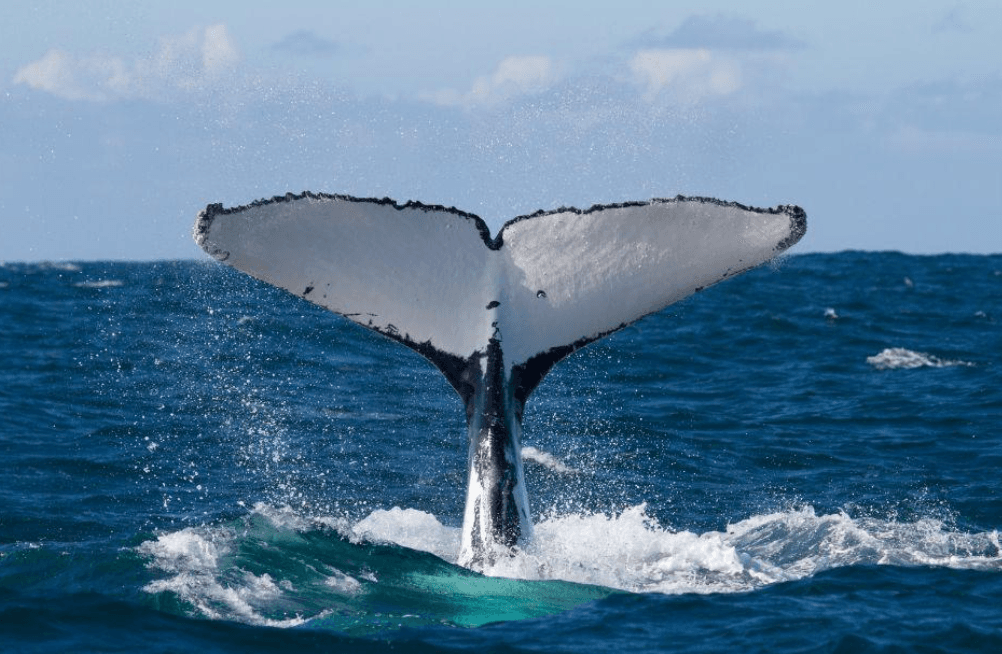
One of the most useful features for identifying an individual humpback whale is the underside of its tail, known as the flukes.
When a whale raises its tail before a deep dive, the underside may become visible above the water. Its coloration, markings, and shape can provide clues that researchers use to distinguish one animal from another.
What Should You Look For?
Pay attention to three main characteristics:
- Color pattern: The underside may contain varying amounts of black, white, and gray.
- Distinctive markings: Irregular patches and contrasting patterns can help create an identifiable visual record.
- Edge shape: The trailing edge of the tail may contain recognizable contours, notches, or scars.
The combination of these features is more useful than any single marking.
Researchers can compare photographs of tail flukes with existing identification catalogs to investigate whether a whale has been documented before.
Why Are Tail Photographs Important?
A clear photograph of a whale's tail can provide valuable identification information when it captures enough of the underside and its distinctive markings.
However, not every whale raises its tail fully during a sighting. A partially visible tail may not provide enough detail for reliable identification.
Visitors should never encourage a whale to dive or change its behavior just to obtain a better view.
2. Examine the Dorsal Fin and Back
Humpback whales also have a small dorsal fin located along the back, closer to the tail than the head.
Although this fin is not as large as the dorsal fins of some other whale species, its shape can vary between individuals.
Some humpbacks have relatively low dorsal fins, while others have more pronounced shapes or irregular contours.
Researchers may use dorsal-fin photographs alongside other observations, particularly when the whale's tail is not visible.
Can You Identify a Whale From Its Dorsal Fin Alone?
Sometimes a distinctive dorsal fin can provide a useful clue, but it is generally better to combine several features rather than rely on one.
Viewing angle, distance, water conditions, and the amount of the whale visible above the surface can all affect what you observe.
For reliable scientific identification, researchers consider the quality of the photograph and compare the animal with documented records.
3. Look at the Pectoral Fins
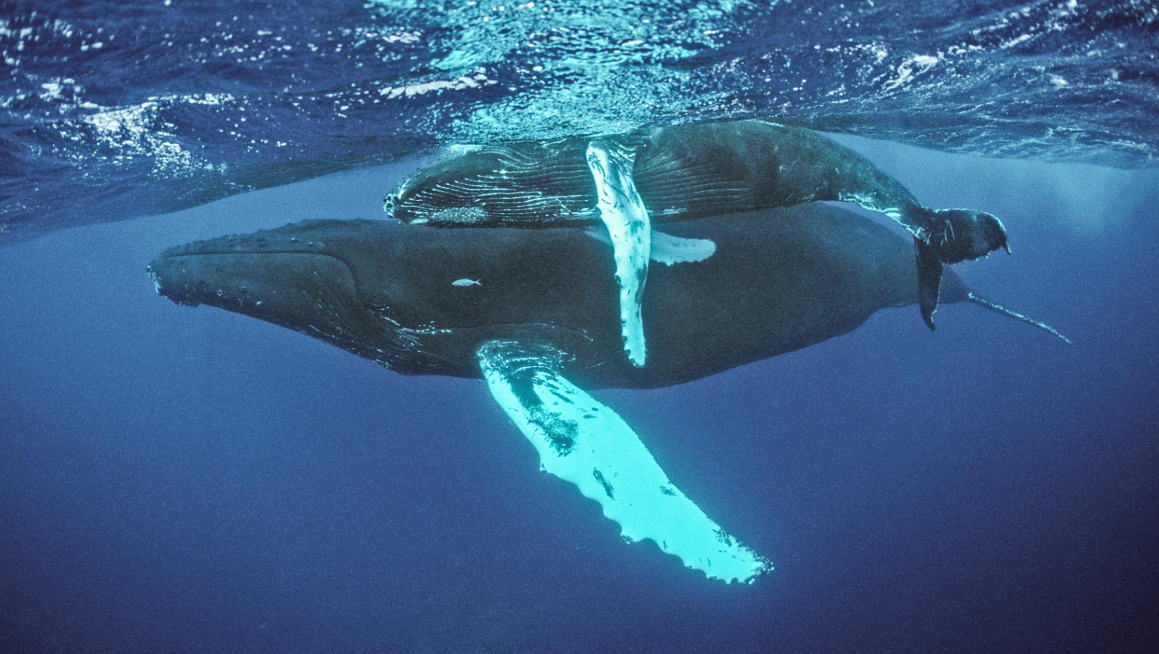
Humpback whales are known for their unusually long pectoral fins, which are located on either side of the body.
These fins can appear mostly white, mostly dark, or patterned with different combinations of colors. The precise appearance varies among individuals.
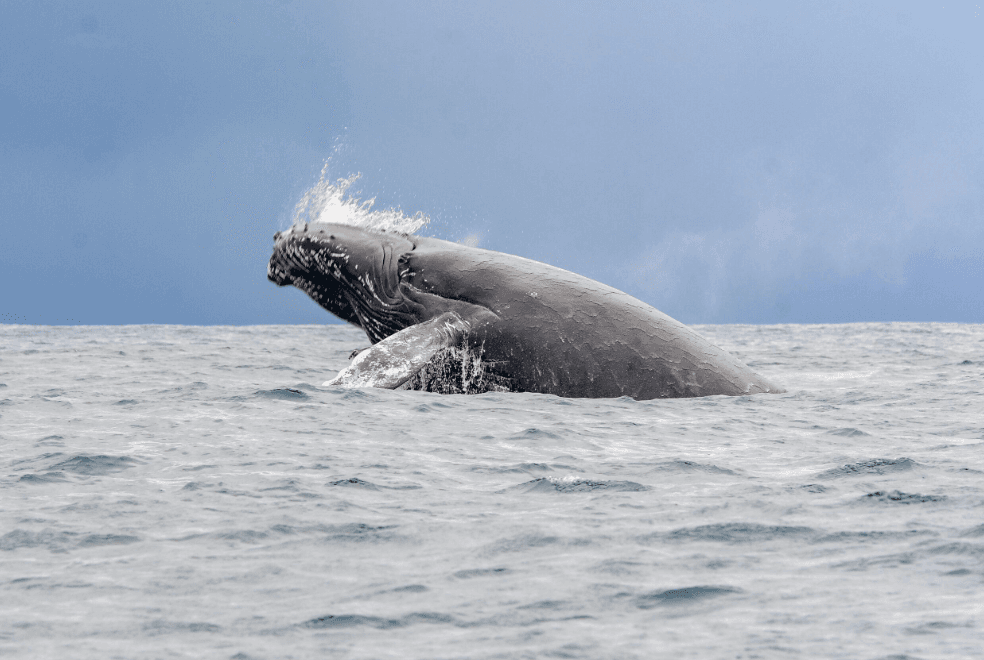
A whale rolling near the surface may reveal part of a pectoral fin. On some occasions, a whale may lift a fin above the water, making its length and coloration easier to observe.
Why Do Pectoral-Fin Markings Matter?
The underside of a pectoral fin can contain distinctive pigmentation patterns. Researchers may document these patterns as an additional way to distinguish individuals.
Nevertheless, pectoral fins are not always visible during a whale-watching encounter. Their appearance can also change with lighting and viewing angle.
Treat these features as useful clues rather than a guaranteed way to identify a specific whale.
4. Notice Scars and Other Natural Markings
Humpback whales may have scars, scratches, and other marks on their bodies.
Some marks may result from interactions with other animals or encounters with objects in the marine environment. Researchers do not automatically know the cause of every scar they observe.
Scars can sometimes help distinguish one whale from another, particularly when they occur in a recognizable pattern.
However, scars may be difficult to see from a moving boat, and some can become less noticeable over time.
A photograph that shows a distinctive combination of markings may be more useful than one that captures only a general view of the whale.
5. Understand Differences in Body Color
Humpback whales generally have dark upper bodies, while their undersides and fins may show varying degrees of lighter pigmentation.
The exact pattern differs between animals.
Some whales display extensive white markings on their tail flukes or pectoral fins, while others have predominantly dark patterns.
Coloration can help researchers distinguish individuals when combined with other physical features.
Keep in mind that sunlight, reflections, water clarity, and the angle of observation may change how a whale's colors appear. A photograph taken in different lighting may look noticeably different even when it shows the same animal.
For this reason, scientists evaluate markings carefully rather than treating every apparent color difference as proof that two whales are different.
6. Can You Identify a Whale by Its Size?
Body size can help with broad observations, but it is not usually sufficient to identify an individual humpback whale.
Adult humpbacks are large animals, while calves are considerably smaller. However, estimating size from a boat can be difficult because the whale may be partly submerged and there may be no reliable reference point.
Water depth, distance, perspective, and the portion of the body visible above the surface can all affect your impression of an animal's size.
Researchers use more systematic methods when they need measurements or reliable information about age and growth.
During a whale-watching trip, it is more accurate to describe a whale as appearing large or small than to assign a precise length based on a brief sighting.
7. How Scientists Build Humpback Whale Identification Catalogs
Scientists and conservation researchers use photographs and observation records to identify and track individual whales.
A technique known as photo-identification is especially important in humpback whale research.
The process generally involves several stages.
Step 1: Photograph Distinctive Features
Researchers collect photographs showing recognizable markings, especially the underside of the tail flukes. Additional photographs may document the dorsal fin, body markings, or pectoral fins.
Step 2: Review Image Quality
Images need sufficient clarity and useful viewing angles. A distant or partially obscured photograph may not support a confident match.
Step 3: Compare With Existing Records
Researchers compare the new photographs with cataloged images of previously documented whales.
A match may indicate that the same individual has been observed again, potentially helping researchers understand its movements over time.
Step 4: Record the Observation
Depending on the research project, records may include the date, location, photographs, and other observations.
Repeated identifications can contribute to studies of migration, population structure, and how frequently whales return to particular areas.
Photo-identification does not require physically tagging every whale. However, results depend on image quality, the coverage of existing catalogs, and the reliability of the matching process.
8. What Can Visitors Identify During a Samaná Whale-Watching Trip?
Visitors may be able to recognize general features, even without scientific equipment.
For example, you might notice the shape of a dorsal fin, the color pattern on a raised tail, or a visible scar.
You may also observe whether a whale is traveling alone or near another whale. These are useful observations, but they do not necessarily establish the animal's identity, age, sex, or relationship to nearby whales.
If your guide discusses an individual whale's identity, ask whether that identification comes from a research catalog or from a general visual impression.
The distinction helps separate verified information from an educated guess.
9. Why Individual Whale Identification Matters
Identifying individual whales allows researchers to investigate questions that cannot be answered by counting sightings alone.
For example, photo-identification can help scientists examine:
- Whether the same whale returns to a region in different years.
- How individuals move between documented locations.
- How often particular whales are observed.
- Whether researchers are seeing previously known animals or individuals not yet cataloged.
- How population patterns change over time.
These records can contribute to broader research on whale migration, population dynamics, and marine conservation.
However, a single photograph cannot answer every question about a whale's life. Reliable conclusions usually depend on multiple observations and careful scientific analysis.
10. How to Observe Identifying Features Without Disturbing Whales
You do not need to get close to a whale to appreciate its distinctive features.
During a responsible excursion, listen to the guide and observe from the location recommended by the crew.
A few helpful practices include:
- Use binoculars if permitted and useful for your excursion.
- Observe the tail when a whale naturally raises it.
- Notice visible body markings without assuming you can identify the individual.
- Keep personal equipment secure on the boat.
- Follow all applicable wildlife-viewing regulations and the captain's instructions.
- Never ask a boat operator to chase, crowd, or disturb a whale to obtain a closer look.
A brief sighting can still be meaningful even if the whale never raises its tail or provides a clear view of its markings.
The goal is to observe the animal respectfully, not to force a particular behavior.
Frequently Asked Questions
Can every humpback whale be identified individually?
No. Researchers can identify many whales from distinctive photographs, but some individuals may not have been documented, and some sightings do not provide enough detail for a confident match.
Which feature is most useful for identifying a humpback whale?
The underside of the tail flukes is especially useful because its pigmentation and markings can be distinctive. Researchers may also use dorsal-fin shape, pectoral-fin patterns, scars, and other visible features.
Can I identify a whale from a photograph I take during a tour?
You may be able to document distinctive features, but reliable identification usually requires a clear image and comparison with existing records. A photograph alone does not automatically establish the whale's identity.
Do humpback whales have fingerprints?
Whales do not have human-style fingerprints. Researchers use distinctive natural markings and photographic records to identify individual animals.
Can scientists tell how old a whale is by looking at its tail?
A tail photograph can help identify an individual, but it does not reliably reveal the whale's exact age. Age assessment requires additional evidence and appropriate scientific methods.
Why is Samaná important for humpback whale research?
The region's seasonal humpback whale presence provides opportunities to observe these animals during their breeding-season migration. Research conducted across different locations can help scientists study movements and population patterns.
Conclusion
Learning how to identify humpback whales reveals an important part of marine research that many visitors may overlook.
The underside of a tail, the shape of a dorsal fin, the patterns on pectoral fins, and distinctive scars can all contribute to identifying individual animals. Scientists combine these features with photographic records and repeated observations to build a more complete picture of whale movements and behavior.
During a visit to Samaná Bay, you may see some of these characteristics for yourself. Even if you cannot identify a particular whale, noticing its natural markings can help you appreciate the individuality of these remarkable marine mammals.

Local explorer & expert guide in Samaná Bay Whale Watching.