How Scientists Count Humpback Whales in Samaná Bay
Every whale-watching season, humpback whales return to the warm waters of the Dominican Republic, including the famous Samaná Bay region. Their seasonal arrival creates an extraordinary wildlife spectacle, but it also raises an important scientific question: how do researchers know how many humpback whales exist?
Counting whales is much more complicated than counting animals gathered in a field. Humpbacks spend much of their time underwater, travel across enormous distances, and may appear in different locations throughout the year. Some individuals are observed repeatedly, while others may never be photographed during a particular research project.
Scientists therefore combine field observations, photographic records, surveys, and statistical techniques to estimate whale populations. These methods help researchers understand population trends and support long-term conservation efforts.
Why Is Counting Humpback Whales Difficult?
Humpback whales are highly mobile marine mammals. A whale seen in Samaná Bay may travel to other Caribbean waters and later migrate toward northern feeding grounds.
This movement makes it difficult to establish a complete count from a single location or day.
Several challenges affect whale population estimates:
- Large geographic ranges: Whales move across extensive areas of the ocean.
- Time underwater: Animals can remain out of sight during surveys.
- Repeated sightings: The same whale may be recorded multiple times.
- Changing conditions: Weather, waves, and visibility affect researchers' ability to detect animals.
- Different survey methods: Each technique has strengths and limitations.
Because of these challenges, scientists often estimate population size rather than claim to have counted every whale individually.
1. Boat-Based Surveys
One way to study humpback whales is to conduct surveys from research vessels.
Researchers follow planned routes, record whale sightings, and collect information such as the location, number of visible animals, and observed behavior. Depending on the project, they may also take photographs or record environmental conditions.
These surveys provide valuable information about where whales are observed and how sightings change across locations or seasons.
However, a boat survey does not automatically reveal the total population. Some whales may be underwater when the vessel passes, and others may be outside the surveyed area.
Scientists account for these limitations when interpreting survey results.
2. Aerial Surveys
Aerial surveys use aircraft to observe whales across selected areas of the ocean. From above, researchers can sometimes cover large areas more quickly than they could from a boat.
Observers may record the number of whales, their locations, and whether they appear to be traveling alone or in groups.
Aerial surveys can be particularly useful for broad-scale monitoring, but they also have limitations. Visibility, sea conditions, the amount of time animals spend underwater, and the survey design can influence what researchers detect.
Aerial and boat-based surveys may therefore complement each other rather than provide identical results.
3. Photo-Identification
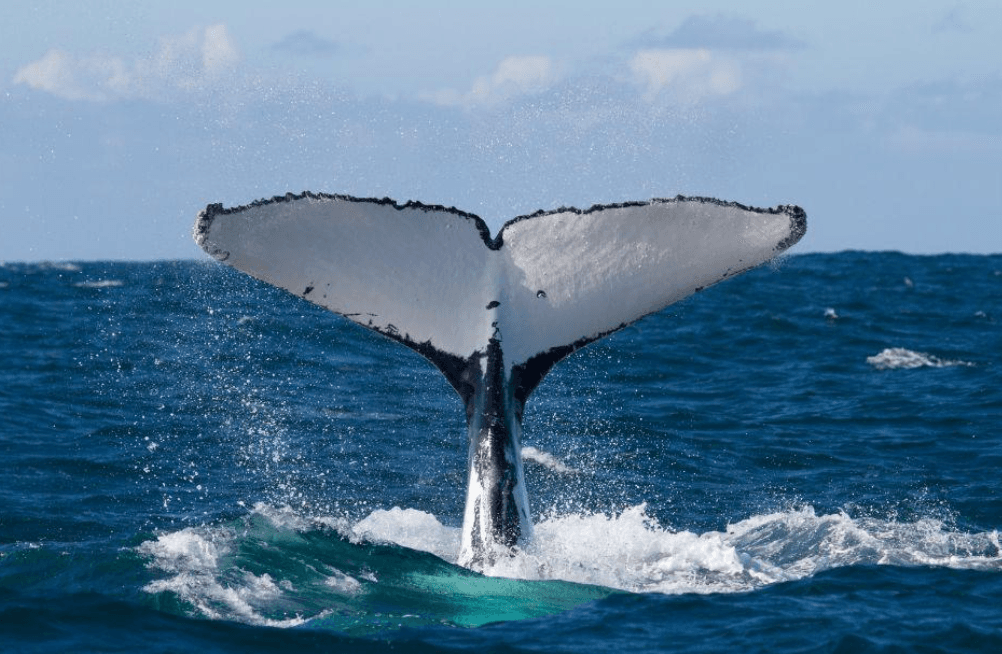
Humpback whales have distinctive tail flukes, and the patterns of pigmentation and markings on the underside can help researchers recognize individual animals.
Scientists photograph these patterns and compare the images with existing records. When a recognizable whale is photographed again, researchers may be able to identify a repeat sighting.
This technique is called photo-identification.
It is especially valuable for studying movements, seasonal return patterns, and how long individual whales are observed across different locations.
However, a photo-identification catalogue is not automatically a complete population count. Some whales are never photographed, some photographs are unsuitable for identification, and the same animal may be recorded by multiple research teams.
Researchers must consider these factors before using photographic records to estimate population size.
4. Capture-Recapture and Mark-Recapture Methods
Scientists sometimes use statistical approaches called capture-recapture or mark-recapture methods to estimate how many animals are in a population.
For whales, researchers may use photographic identification rather than physically capturing the animals.
The general idea is to compare observations from different sampling periods. If researchers photograph a group of identifiable whales and later photograph another group, the proportion of animals seen in both samples can help inform a population estimate.
For example, imagine a simplified research project in which scientists photograph whales during an initial survey and then conduct another survey later. If relatively few individuals from the second sample match the first, that pattern may suggest that many whales were not recorded during the initial survey.
This is only a simplified illustration. Real analyses require statistical models and assumptions about sampling, identification accuracy, animal movement, and the population being studied.
A whale population estimate cannot be calculated reliably from a small set of photographs without considering these factors.
5. Acoustic Monitoring
Humpback whales produce complex sounds, including songs and other vocalizations. Researchers can use underwater microphones, known as hydrophones, to record these sounds.
Acoustic monitoring helps scientists investigate when whales are vocalizing and how their acoustic activity changes across locations or seasons.
It can also provide evidence that whales are present in an area even when visual observations are limited.
However, detecting whale sounds is not the same as counting individual whales. One whale may vocalize repeatedly, multiple whales may vocalize at the same time, and some animals may be silent during a recording period.
For that reason, acoustic information is often most useful when combined with other observations and appropriate analytical methods.
6. Statistical Models Turn Sightings Into Estimates
After collecting observations, researchers analyze the data to estimate population size or examine population trends.
Different studies may use different methods depending on their goals and the information available.
Some approaches account for the chance that an animal will be detected during a survey. Others use repeated photographic sightings, movement information, or data from multiple sampling periods.
Researchers may also report uncertainty around their estimates. This is important because the number produced by a statistical model is not necessarily the exact number of whales alive.
A population estimate is most useful when readers understand the method used, the geographic area covered, the period studied, and the uncertainty associated with the result.
How Do Scientists Study Humpback Whales Around Samaná?
Samaná Bay is an important seasonal area for North Atlantic humpback whales during the breeding season. Researchers interested in whales in this region may investigate seasonal presence, movement, individual sightings, and the relationship between Caribbean breeding areas and northern feeding grounds.
Different studies may cover different parts of the whales' range. A survey conducted in Samaná cannot, by itself, count every North Atlantic humpback whale because many animals spend part of the year elsewhere.
To understand the wider population, researchers may need information from several locations and seasons, together with methods that account for movement and the likelihood of detecting whales.
This broader perspective helps explain why local whale sightings and regional population estimates answer different scientific questions.
Does Seeing More Whales Mean the Population Is Growing?
Not necessarily.
Visitors may see many whales during one trip and fewer on another. These differences can occur even if the overall population has not changed.
Possible explanations include:
- Different numbers of whales being present in the surveyed area.
- Changes in weather or visibility.
- Differences in the time or route of the survey.
- Whales spending different amounts of time underwater.
- Seasonal changes in whale movements.
Scientists therefore look at consistent data collected over time rather than relying on a single busy day or an individual whale-watching excursion.
Long-term monitoring is particularly useful because it helps researchers distinguish short-term variation from more persistent population trends.
Why Are Whale Population Estimates Important?
Population estimates help scientists and conservation organizations evaluate the status of whale populations and identify questions that require further investigation.
Reliable estimates can support several goals:
Monitoring population trends: Repeated estimates can help researchers assess whether a population appears to be increasing, decreasing, or remaining relatively stable.
Understanding distribution: Surveys and identification records help reveal where whales are observed at different times of year.
Evaluating conservation measures: Population information can contribute to broader assessments of threats and conservation actions.
Supporting future research: Identifying gaps in available information helps researchers plan where and how to collect additional data.
Population estimates are only one part of conservation. Researchers may also study habitat conditions, human activities, reproduction, health, and other factors that affect whale survival.
Can Tourists Help Scientists Count Whales?
In some research programs, trained volunteers or members of the public can contribute photographs and sighting information. This is often part of a broader approach known as citizen science.
Photographs of identifiable tail flukes may be useful when they meet a project's requirements and can be linked to reliable information about where and when the animal was observed.
However, not every whale photograph is suitable for scientific identification. Blurry images, incomplete views, and missing location details may limit their value.
If you are interested in contributing, ask whether a recognized whale research project accepts public observations and follow its submission guidelines.
Do not approach whales or change your behavior on a boat to obtain a photograph. Responsible wildlife observation must come before data collection.
What Should Visitors Understand About Whale Counts?
When you read a report about humpback whale numbers, look beyond the headline figure.
Useful questions include:
- What geographic area does the estimate cover?
- Which years or seasons were included?
- Was the estimate based on photographs, surveys, statistical models, or a combination of methods?
- Does the figure refer to all whales in a population or only those observed in one location?
- What uncertainty did the researchers report?
These questions help distinguish a regional population estimate from a count of whales observed in Samaná Bay during a particular survey.
They also explain why estimates from different studies may not be directly comparable.
Frequently Asked Questions
How do scientists know how many humpback whales exist?
Researchers combine methods such as boat surveys, aerial surveys, photo-identification, and statistical modelling. The appropriate method depends on the population and the question being studied.
Can scientists identify every humpback whale?
No. Distinctive tail-fluke patterns can help identify many individual humpbacks, but not every whale is photographed clearly or recorded in a catalogue.
Are whale photographs useful for scientific research?
They can be. Suitable photographs may help researchers recognize individuals, document sightings, and study movements when submitted with reliable information and used within an appropriate research framework.
Does an acoustic recording tell scientists how many whales are present?
Not on its own. A recording can establish that whale sounds were detected, but estimating the number of individual animals requires additional evidence and suitable analytical methods.
Can a whale-watching tour count as a scientific survey?
An ordinary tourist excursion is not automatically a scientific survey. Research surveys generally use planned methods, systematic records, and procedures designed to answer specific scientific questions.
Why do whale population estimates sometimes differ?
Studies may cover different areas, years, or groups of animals and use different sampling methods or statistical assumptions. Researchers need to consider these differences before comparing the results.
Understanding the Science Behind Samaná Whale Watching
Every whale sighting in Samaná Bay is part of a much larger scientific picture. Researchers use photographs, surveys, acoustic recordings, and statistical methods to understand whale populations that move across vast areas of the North Atlantic.
Counting humpback whales is not simply a matter of recording every animal seen from a boat. It requires careful study of repeated sightings, detection limitations, animal movements, and uncertainty.
For visitors, learning about these methods adds another dimension to whale watching. Beyond the excitement of seeing a whale at the surface, there is a continuing scientific effort to understand the animals, the places they use, and how best to protect them.

Local explorer & expert guide in Samaná Bay Whale Watching.