How Do Scientists Determine the Depth of a Singing Humpback Whale?
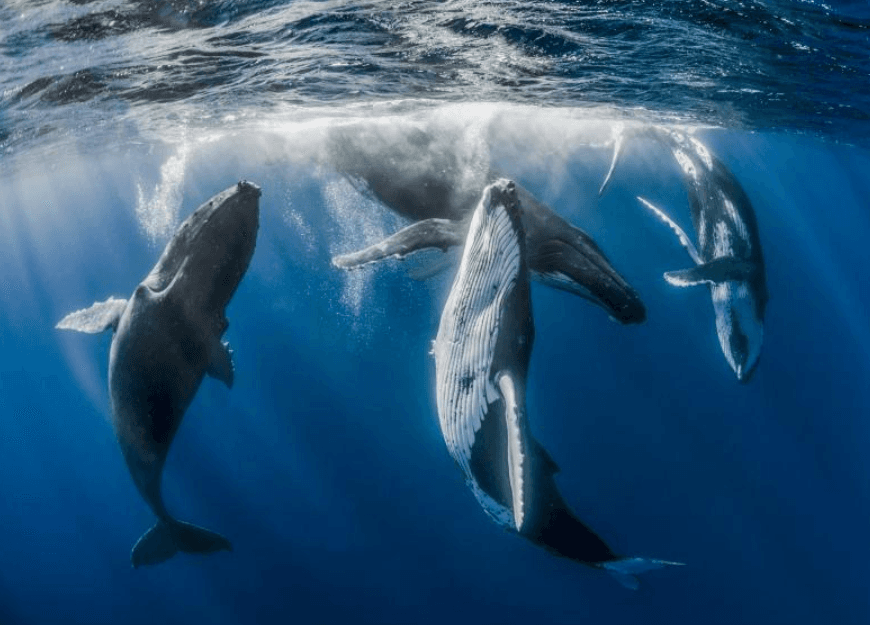
Humpback whales are famous for their complex underwater songs. During the breeding season, these sounds can travel through the ocean and be detected by specialized recording equipment. But listening to a whale is only part of the scientific challenge. Researchers may also want to understand where the animal is located beneath the surface, including how deep it is when it sings.
Determining the depth of a singing humpback whale is not as simple as listening to its voice. Underwater sound can travel considerable distances, reflect off the seabed, and reach recording equipment by several different paths. A recording may reveal that a whale is singing without providing enough information to determine its exact vertical position.
Scientists therefore combine acoustic measurements, knowledge of the underwater environment, and, when available, independent tracking data. These methods help researchers investigate how whale depth relates to singing, movement, and the surrounding marine habitat.
For visitors interested in Samaná whale watching in the Dominican Republic, understanding this research offers another way to appreciate the behavior of humpback whales beneath the surface.
Why Does a Singing Whale’s Depth Matter?
A whale’s depth can influence how its sounds travel through the ocean and how researchers detect them. It can also help scientists investigate the relationship between vocal behavior and movement.
For example, researchers may ask whether a singing whale maintains a relatively steady depth, changes depth during a song, or moves while continuing to vocalize. These are research questions rather than assumptions about what every whale does.
Depth information can also help scientists interpret acoustic recordings. A sound recorded at one hydrophone may have traveled directly from the whale, while another recording may contain sound that has reflected off the seabed or the sea surface. Knowing the likely source depth can help researchers assess which explanations are plausible.
However, a whale’s depth alone does not explain why it sings. Researchers must consider other factors, including the animal’s behavior, the local environment, and whether other whales are nearby.
1. Recording Whale Songs With Hydrophones
One of the main tools for studying underwater whale sounds is the hydrophone. This instrument detects sound pressure underwater and converts it into a signal that researchers can record and analyze.
Hydrophones may be deployed from research vessels, attached to moorings, or incorporated into other underwater monitoring systems. Some are positioned at known depths, while others are part of larger arrays designed to capture sounds from different locations.
When a humpback whale sings, its vocalizations may be recorded as a series of tones, pulses, and repeating sound patterns. Researchers examine these recordings to identify the calls or songs and compare the signals detected by different instruments.
A single hydrophone can provide useful information about sound timing, frequency, and intensity. However, one recording by itself generally cannot establish the exact depth of the singing whale.
The instrument records the sound that reaches it, not a direct measurement of the animal’s position.
2. Using Multiple Hydrophones to Estimate Position
When researchers use several hydrophones at known locations, they can compare the timing and characteristics of the same sound across different recordings.
If a recognizable sound reaches one hydrophone before another, the time difference can help constrain the possible location of the source. With suitable equipment, accurate synchronization, and a well-understood environment, these measurements can contribute to three-dimensional acoustic localization.
Three-dimensional localization estimates position along three axes: horizontal location, distance, and vertical position. The vertical component is what researchers need to estimate the whale’s depth relative to the water surface.
The process requires more than simply placing two recorders in the water. Researchers must know the hydrophones’ positions, account for sound-travel time, and distinguish the same vocalization across recordings.
The result may be an estimated location with an uncertainty range rather than an exact depth. Accuracy depends on the arrangement of the hydrophones, recording quality, environmental conditions, and the quality of the acoustic measurements.
3. Measuring Sound Travel Through Water
Sound does not travel at precisely the same speed everywhere in the ocean. Water temperature, salinity, and pressure all affect sound speed.
These factors can create layers in which sound travels along curved paths instead of following a straight line. As a result, the route taken by a whale’s song may be more complicated than a simple distance calculation suggests.
To interpret acoustic measurements, researchers may collect information about the water column and use an appropriate sound-propagation model. Such models help estimate the paths that sound could take between a whale and a hydrophone.
This matters for depth estimation because different sound paths can produce different arrival times. A reflected sound may arrive later than a direct sound, potentially confusing a calculation if the paths are not correctly identified.
A model cannot eliminate every uncertainty, but it can help researchers determine which source positions are consistent with the recorded data.
4. Studying Reflections From the Sea Surface and Seabed
Underwater sound can reflect off boundaries such as the sea surface and the ocean floor. These reflections may appear in a recording alongside the direct sound.
The seabed can be especially important in shallow coastal environments. Its depth, slope, and material properties influence how sound is reflected or absorbed. The sea surface can also affect the signal, depending on conditions and the geometry of the source and receiver.
Researchers may examine the arrival times and characteristics of direct and reflected sound to help constrain a source’s position. They must be careful, however, because reflections can overlap and may not always be distinguishable in noisy recordings.
This is one reason that determining whale depth can be difficult in coastal waters. The same vocalization may reach a recorder by more than one route, and those routes may carry different information about the source.
A reliable analysis therefore considers the local underwater environment instead of treating every recorded signal as though it traveled directly from the whale.
5. Combining Acoustic Recordings With Tracking Instruments
Acoustic localization is not the only way to investigate the depth of a singing humpback whale. Researchers may combine sound recordings with tracking instruments when appropriate and feasible.
For example, a research tag attached to a whale may contain a pressure sensor that records changes in depth. Depending on the tag design, it may also collect movement or acoustic data.
Pressure measurements provide a direct way to estimate how far below the water surface a tagged animal travels. Researchers can then compare the animal’s depth record with the timing of vocalizations or other acoustic observations.
There are important limitations. A tag must be attached to the correct animal, and the researchers need a reliable way to connect the recorded sounds with that individual. Not every tag records sound, and not every whale can be tagged.
Tagging also requires appropriate permits, expertise, and animal-welfare procedures. It is not necessary for every whale study, and researchers must carefully weigh the scientific value against potential effects on the animal.
When independent tracking and acoustic data are available, they can provide complementary evidence. When they are not, scientists must be more cautious about attributing a particular depth to a singing whale.
6. Understanding What Acoustic Data Can—and Cannot—Reveal
A recording may clearly contain a humpback whale song while leaving its depth uncertain. This distinction is important because detecting a sound and locating its source are different scientific tasks.
A single hydrophone recording might establish when a song occurred and provide information about its acoustic structure. With additional equipment and suitable conditions, researchers may estimate the source’s location, including its vertical position.
Even then, the estimate has limitations. Background noise, overlapping songs, uncertain sound paths, instrument movement, and incomplete environmental measurements can affect the result.
Researchers may report a likely depth range or a location with a quantified uncertainty rather than a single exact number. They may also reject an estimate if the evidence is not strong enough.
Good scientific interpretation makes those limitations clear. It does not turn an uncertain acoustic estimate into a precise claim simply because a numerical result can be calculated.
7. Does a Humpback Whale Sing at the Same Depth All the Time?
Scientists should not assume that a singing humpback whale remains at one depth throughout a song. Whether its depth changes depends on the individual animal and the behavior being studied.
A researcher investigating this question could compare repeated acoustic location estimates over time or combine recordings with depth measurements from a suitable tracking tag. The resulting data could show whether the whale remained at a similar depth or moved vertically while singing.
Such an investigation would also need to consider the accuracy and frequency of the measurements. If the recording system only provides occasional position estimates, short movements might go undetected. If the sound source cannot be tracked continuously, researchers may not know exactly when or where a depth change occurred.
The song itself should not be treated as a reliable depth gauge. A change in pitch or loudness does not automatically mean the whale has moved closer to the surface or descended deeper into the water.
Depth must be estimated using suitable measurements and an appropriate analysis, not inferred from how a song sounds to a human listener.
8. Why Depth Research Can Be Challenging in Samaná Bay
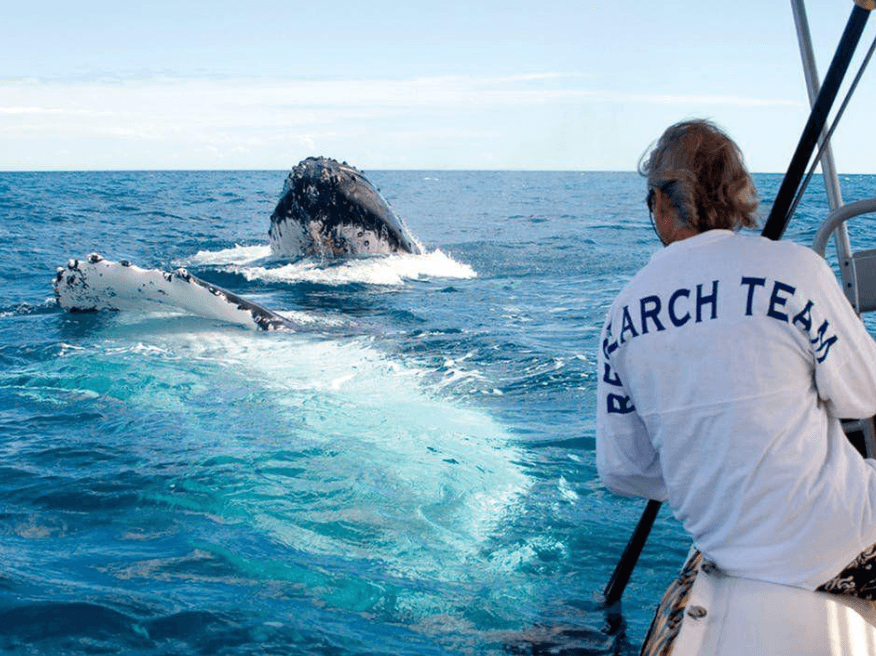
Samaná Bay is well known as a destination for observing humpback whales during the breeding season. Visitors often see whales surfacing, breathing, diving, or raising their flukes before descending.
But the visible portion of a whale’s behavior is only part of its activity. Once the animal is underwater, observers from a tour boat cannot usually determine its exact depth by sight.
Scientific research in coastal waters may also face practical acoustic challenges. Water depth varies by location, vessels can contribute background noise, and underwater conditions affect sound propagation. These factors must be considered if researchers want to estimate a singing whale’s position accurately.
The methods described in this article are general scientific approaches. They should not be taken as evidence that a particular depth-monitoring study has been conducted in Samaná Bay.
A local study designed to investigate singing depth would need appropriate equipment, a carefully planned deployment, environmental measurements, and a method for assessing uncertainty.
Such research could help scientists explore how humpback whale vocal behavior relates to underwater movement in a breeding-ground environment.
9. What Can Whale Watchers Learn From This Science?
You do not need to know a whale’s exact depth to appreciate its behavior. Observing the sequence of a dive, the timing of a surfacing, or the appearance of a tail fluke can help you understand what is visible above the water.
Acoustic research adds another perspective: it shows how scientists can investigate activity that cannot be directly observed from a boat.
It is important to distinguish observation from interpretation. Seeing a whale dive does not reveal its exact underwater path, and hearing a whale song through specialized equipment does not automatically establish where the singer is located.
Visitors can gain a fuller understanding of humpback whales by combining responsible wildlife observation with accurate information about their biology and the scientific methods used to study them.
During a whale-watching excursion, follow the crew’s instructions, remain seated or positioned safely when required, and respect applicable wildlife-viewing rules. Allow the whales to determine their own movements rather than expecting them to surface or dive on a schedule.
Conclusion: Estimating the Depth of a Singing Humpback Whale
Scientists estimate the depth of a singing humpback whale by combining suitable acoustic measurements with information about underwater sound propagation and, where available, independent tracking data.
Hydrophones detect the song, multiple recording stations can help constrain the source’s position, and scientific models account for how sound travels through the water. Tracking instruments with pressure sensors may provide additional depth information when researchers can ethically and reliably collect those measurements.
No single method works perfectly in every situation. The quality of a depth estimate depends on the equipment, the environment, the recording conditions, and the evidence available to support the result.
For anyone interested in Samaná whale watching, this science reveals how much of a humpback whale’s life takes place beyond the surface. Seeing a whale rise to breathe is a remarkable experience; learning how researchers investigate its underwater world makes that experience even more meaningful.
Planning to experience humpback whales in Samaná? Explore responsible whale-watching options, check the seasonal conditions before traveling, and choose an operator that follows applicable wildlife-viewing guidelines. Enjoy the encounter while remembering that every sighting offers only a glimpse into a much larger underwater world.

Local explorer & expert guide in Samaná Bay Whale Watching.